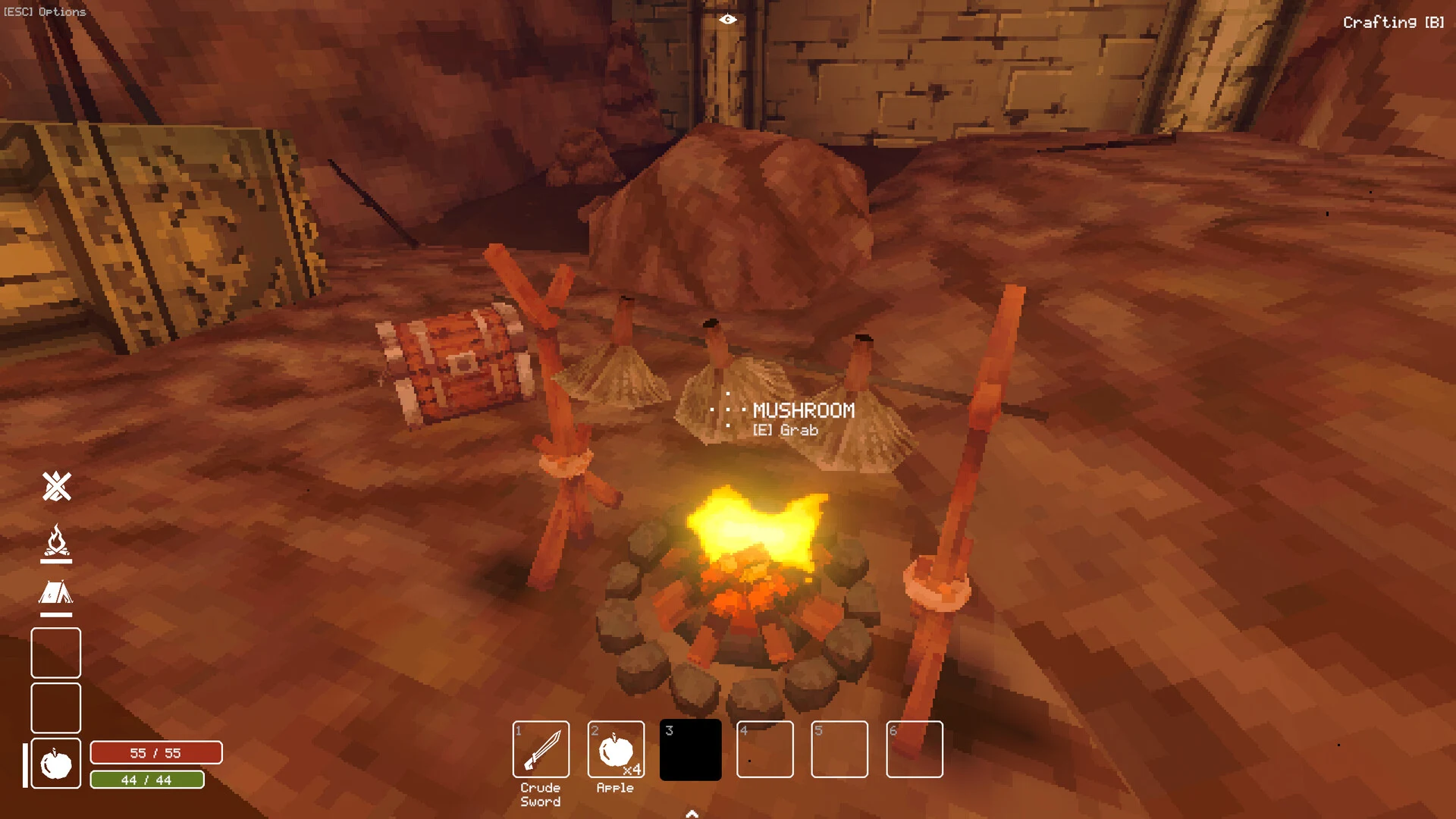
- Deep Dish Dungeon progression follows a Metroidvania-like loop: explore, get blocked, gain abilities, return.
- Cooking and crafting are the engine of advancement; every run should improve the next preparation cycle.
- Route memory matters; note blocked passages and revisit them after new unlocks.
- Solo or 3-player co-op both work, but co-op demands role division and shared resource planning.
- The full game launches October 13, 2026 on Steam and Xbox platforms.
How Deep Dish Dungeon Progression Works
Progression in Deep Dish Dungeon is not a straight line. The dungeon is handcrafted with branching routes, environmental puzzles, and passages that stay locked until you gain the right tool or ability. Each run teaches you the layout, and each preparation cycle — gathering, crafting, cooking — pushes you a little deeper.
Video Highlights:
- Handcrafted dungeon spaces with branching paths and hidden resources
- Environmental puzzles gate progression, not just combat
- Ability unlocks open previously unreachable routes
- Cooking and crafting support longer, safer expeditions
The core loop breaks down into four interlocking pillars:
| Pillar | Role in Progression | What It Unlocks |
|---|---|---|
| Exploration | Reveals routes, resources, and blocked passages | Mental map of the dungeon, new materials |
| Ability Unlocks | Metroidvania-style movement and access upgrades | Previously unreachable areas |
| Crafting | Turns gathered materials into tools and supplies | Longer expeditions, better hazard handling |
| Cooking | Converts ingredients into health/stamina support | Survival through combat-heavy routes |
Early progress comes from learning the world and improving preparation, not from clearing every area in one attempt. A "failed" run that maps a new branch is still progress.
Step-by-Step Advancement Route
Follow this sequence to advance efficiently through the early and mid game:
Learn the Controls and Systems
Practice movement, interaction, combat, and inventory management before pushing deep. Comfort switching between actions is the foundation for everything that follows.
Explore Systematically and Mark Blockages
Follow open paths, check side rooms, and memorize every locked door or unreachable ledge. These are your future progression checkpoints.
Gather Before Pushing Deeper
Collect materials and ingredients along every route. Keep a reserve instead of spending everything immediately — future recipes need stockpiles.
Prepare Food and Craft With Purpose
Identify what currently limits you — survival, recovery, traversal, or access — and craft and cook specifically for that obstacle.
Return With New Abilities
After each unlock, revisit blocked areas. Ability-based progression means old zones often hide shortcuts, secrets, and resources.
Do not spend every material the moment it enters your inventory. Craft with a specific purpose, especially early on when materials are scarce.
Preparation Systems: Cooking and Crafting Priorities
Your two preparation systems, cooking and crafting, determine how deep a single run can go. Match them to the obstacle ahead.
| Preparation Type | Best Used Before | Purpose | Priority |
|---|---|---|---|
| Health-focused food | Combat-heavy routes, post-damage recovery | Room for mistakes in dangerous encounters | ★★★★★ |
| Stamina-focused food | Traversal, puzzles, extended movement | Sustained navigation and ability use | ★★★★ |
| Practical tools | Any blocked or hazardous route | Gathering, hazard handling, exploration | ★★★★★ |
| Balanced meal plan | Routes with mixed challenges | Coverage for combat plus puzzles plus backtracking | ★★★★ |
| Resource reserves | Between runs | Flexibility for future crafting cycles | ★★★ |
Review what was consumed, what blocked you, and what was scarce. Adjust the next crafting and cooking plan accordingly — every run should improve the next preparation cycle.
Solo vs Co-op Progression
Progression works in both solo and up-to-3-player co-op, but the pacing changes. A coordinated party can divide responsibilities and cover more ground safely.
Solo Play
- Full control over every decision
- Slower but steady exploration pace
- All resources under one inventory plan
Co-op Roles
- Assign explorer and support roles
- One player draws enemy attention, others attack
- Communicate before spending limited resources
Shared Route Planning
- Agree on a route before splitting up
- Compare puzzle observations as a group
- Reserve key resources for unavoidable fights
Avoid separating the party during dangerous encounters. Focusing on one threat at a time is the strongest cooperative combat pattern.
Progression Milestones Checklist
Core Progression Milestones:
- Comfortable with all movement and combat controls
- Mental map of all blocked routes near the starting area
- Stable reserve of cooking ingredients and craft materials
- First ability unlock used to open a previously blocked path
- A completed run cycle: explore, return, cook, craft, push deeper
FAQ
Q: Is Deep Dish Dungeon progression level-based or ability-based?
It follows a Metroidvania-like ability-based structure. New abilities expand movement and exploration options, unlocking routes that were previously blocked rather than relying on raw level grinding.
Q: What should I prioritize first when progressing?
Prioritize practical tools and recovery-oriented food. Identify the immediate obstacle — survival, recovery, traversal, or blocked access — and prepare specifically for it instead of crafting for every possible situation.
Q: Can I progress the same way in co-op as solo?
Yes, the progression systems are the same, but co-op rewards coordination. Divide exploration and support roles, communicate before dangerous rooms, and discuss resource usage before spending limited supplies.
Q: When does the full game release?
Deep Dish Dungeon launches October 13, 2026 on Steam, Xbox Series X|S, Xbox PC, Xbox Cloud Gaming, and Xbox Game Pass. A demo is currently available on Steam and Xbox.