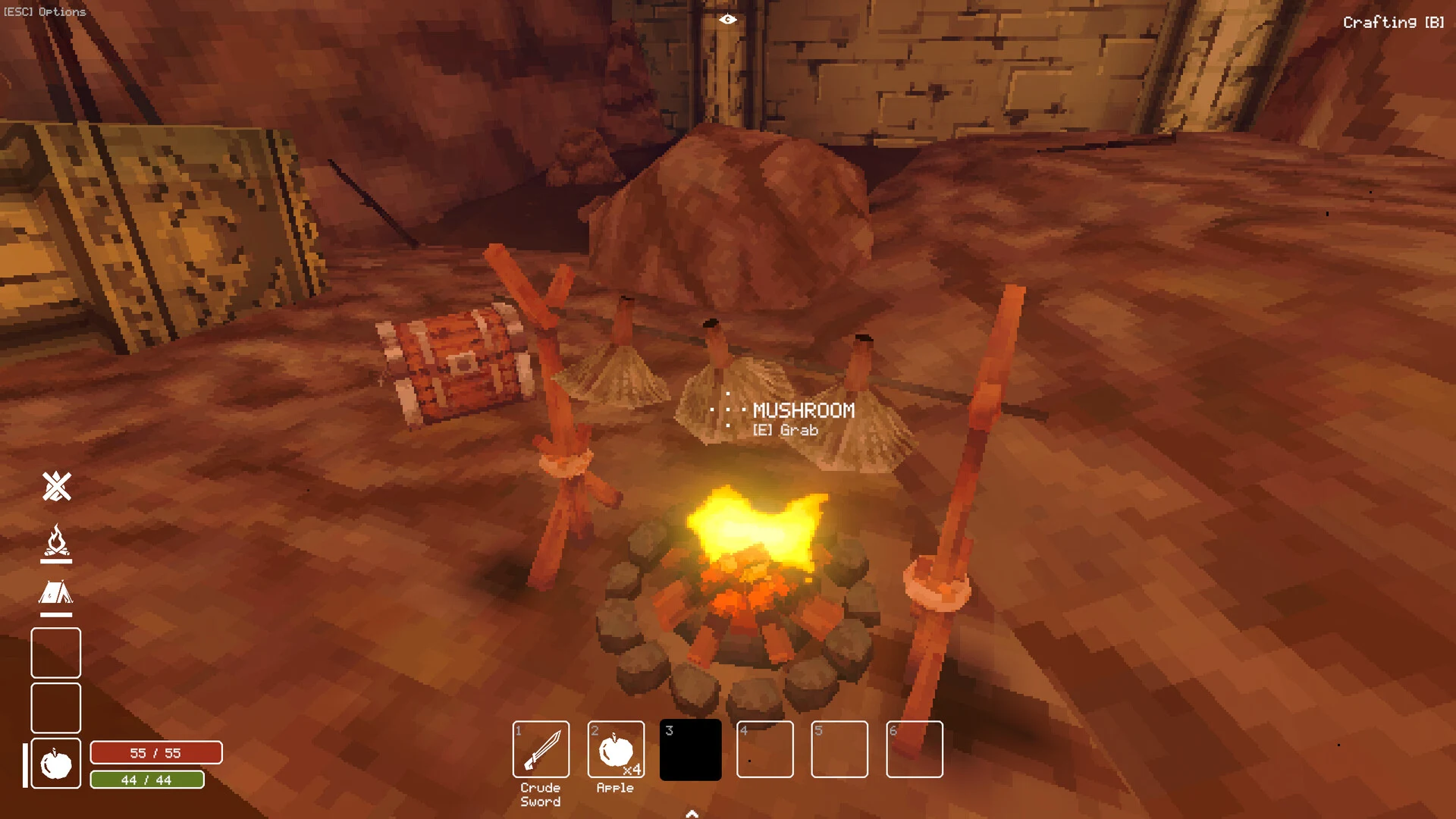
- Deep Dish Dungeon co-op supports solo play or online sessions with up to 3 players total.
- Coordination matters: dividing combat, puzzles, and resource duties keeps the party alive.
- Platform access: co-op is available on Steam, Xbox Series X|S, Xbox PC, and Xbox Cloud Gaming.
- Release timing: the full version launches October 13, 2026, with a demo playable now.
- Preparation wins: cook meals and craft supplies together before pushing into deeper dungeon sections.
How Deep Dish Dungeon Co-op Works
Deep Dish Dungeon co-op lets you take on the handcrafted dungeon either entirely alone or with up to two friends, for a maximum party of three. Developer Behold Studios and publisher Raw Fury designed the game around exploration, environmental puzzles, cooking, crafting, and ability-based progression, and every one of those systems carries over into multiplayer. A coordinated group can split responsibilities, cover each other in combat, and pool ingredients and materials far more efficiently than a solo adventurer.
Video Highlights:
- Official overview of exploration, cooking, and combat systems
- How cooperative play fits into the dungeon loop
- First look at puzzle interaction in multiplayer context
The core difference between solo and co-op comes down to control and pace. In solo, you manage every decision yourself — when to fight, when to retreat, what to cook. In a three-player session, those decisions become shared, which means communication is your most valuable tool.
| Aspect | Solo | Co-op (Up to 3 Players) |
|---|---|---|
| Decision-making | Fully personal | Discussed and coordinated |
| Combat | One target, full attention | Roles such as bait and attacker |
| Puzzles | Single observation | Shared clues and faster solving |
| Resources | One inventory mindset | Open discussion before spending |
| Risk | One death ends the run | Team can regroup and recover |
Use voice or text chat before entering unfamiliar rooms. Agreeing on a route and a retreat plan takes seconds and saves entire runs.
Setting Up an Online Session
Starting a multiplayer session is straightforward, but a few preparation habits make the experience much smoother — especially for groups mixing new and experienced players.
Confirm Everyone Has Access
Make sure all players own the game or have access through their platform of choice — Steam, Xbox Series X|S, Xbox PC, Xbox Cloud Gaming, or Xbox Game Pass. The demo is a good way to check compatibility before the October 13, 2026 launch.
Create or Join a Session
Use the game's multiplayer option to create a session for your group, then invite friends through the available multiplayer flow, or join an existing session.
Agree on Roles Before Entering
Decide who focuses on combat, who watches puzzles and environmental clues, and who manages food and materials. Roles can be flexible — the point is to avoid duplicated effort.
Set a Shared Route
Choose which dungeon branch to explore together, and agree on a fallback meeting point if the party gets separated.
Review After Each Run
After returning to camp, discuss what blocked progress, what resources ran low, and what to cook or craft before the next attempt.
The game launches across Steam and Xbox ecosystem entry points on October 13, 2026. Check the official store listing for current cross-platform play details before coordinating with friends on different platforms.
Team Roles and Combat Coordination
Cooperative combat in Deep Dish Dungeon works best when players avoid overlapping actions and keep track of threats together. One player can draw enemy attention while another positions for a safer attack, and a third manages recovery food or watches for hazards.
Frontline
- Draws enemy attention
- Controls positioning
- Absorbs and avoids damage first
Flanker
- Waits for openings
- Handles safer attacks
- Finishes isolated enemies
Support
- Manages food and stamina
- Tracks puzzle clues
- Calls retreats when low on resources
| Combat Principle | Why It Matters |
|---|---|
| Focus one threat at a time | Splitting damage across enemies prolongs danger |
| Stay together in hard rooms | Separated players are harder to rescue |
| Communicate before healing items | Limited recovery supplies should be spent deliberately |
| Learn attack patterns as a group | Shared knowledge prevents repeated mistakes |
| Retreat is an option | Regroup, cook, and return prepared |
Exploring alone during dangerous encounters is the fastest way to lose a run. If a branch looks tempting, flag it to the team and return together later.
Puzzles, Cooking, and Resource Sharing
Puzzles and preparation are where a three-player group outperforms a solo run the most. Treat every environmental puzzle as a group activity: compare observations before anyone interacts with mechanisms, because a wrong interaction can cost limited items or trigger hazards.
For cooking and crafting, the gathering loop feeds both systems. Ingredients collected along the route become meals that support health and stamina, and materials become tools and supplies. In co-op, discuss resource spending openly so the party preserves supplies for the rooms ahead.
| Preparation Task | Best Timing | Co-op Practice |
|---|---|---|
| Ingredient gathering | Every exploration route | Assign one player to spot nodes |
| Cooking meals | Before deeper or unfamiliar areas | Cook together at camp before departing |
| Health-focused food | Before combat-heavy routes | Support role manages the stock |
| Stamina-focused food | Before traversal or puzzle sections | Distribute to whoever leads the route |
| Material reserves | Always | Agree on a shared reserve rule |
A simple rule works well: nothing limited gets spent without a quick callout. This keeps recovery food and crafting materials available for the encounters that truly need them.
Co-op Readiness Checklist
Run through this checklist as a group before committing to any deep dungeon attempt.
Before Your Next Co-op Run:
- All players can access the same session and platform
- Roles assigned: frontline, flanker, support
- Meals cooked for both health and stamina
- Crafting materials reserved for the planned obstacle
- Route and fallback meeting point agreed on
If your group is new, run the demo together first. It is a low-stakes way to practice communication, combat timing, and puzzle coordination before the full release on October 13, 2026.
FAQ
Q: How many players does Deep Dish Dungeon co-op support?
Deep Dish Dungeon supports solo play plus cooperative sessions with up to two friends, for a maximum of 3 players per party, as confirmed in the official Raw Fury announcement.
Q: When does Deep Dish Dungeon release?
The full version is planned for release on October 13, 2026, on Steam, Xbox Series X|S, Xbox PC, Xbox Cloud Gaming, and Xbox Game Pass. A demo is currently available on Steam and Xbox.
Q: Is co-op better than solo in Deep Dish Dungeon?
Neither is strictly better. Solo gives full control over every decision, while co-op allows role division, shared puzzle-solving, and pooled resources. Co-op rewards communication; solo rewards self-reliance.
Q: What is the biggest mistake in co-op runs?
Splitting up during dangerous encounters and spending limited recovery items without discussing it. Stay together, focus one threat at a time, and communicate before using shared resources.